Healthcare interoperability sandbox
HL7 / FHIR / SOAP Integration Lab
A lightweight technical sandbox for exploring healthcare interoperability workflows, payload validation, integration patterns, and implementation-oriented experimentation across HL7, FHIR, and SOAP-based systems.
Demo preview
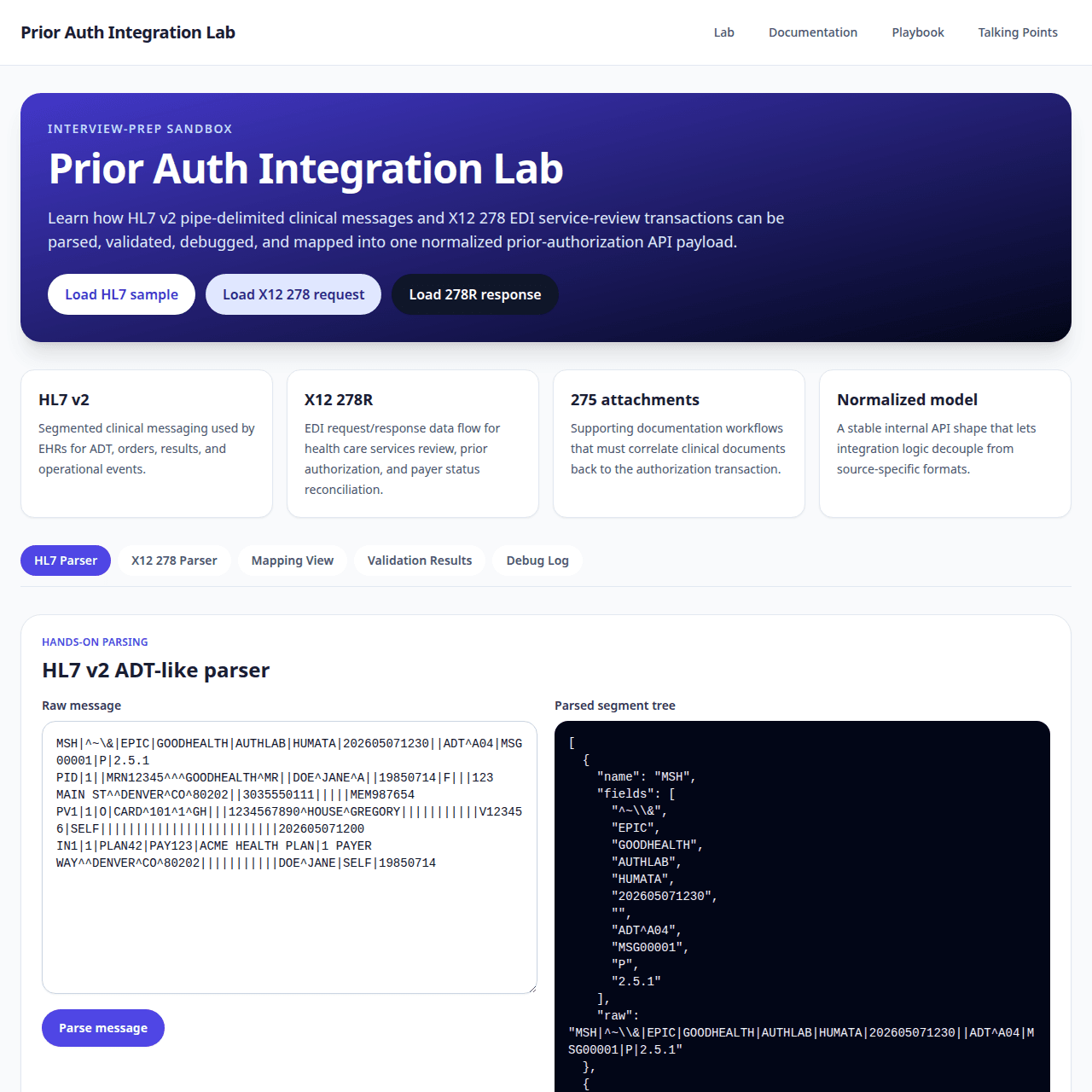
Interoperability sandbox
Small payload experiments make abstract standards easier to reason about
The lab is intentionally lightweight: a place to inspect inputs, test validation ideas, and think through workflow behavior without presenting the project as a production healthcare application.
MSH|^~\&|APP|LAB|EHR|...
PID|1||12345||Patient^Example
GET /fhir/Patient/12345
SOAP: <Envelope>...</Envelope>
Standards and concepts
HL7 messaging
Exploring segment-oriented payloads, message structure, and how small data-shape details can affect downstream workflows.
FHIR APIs
Working with resource-oriented API patterns, request/response behavior, and practical validation around healthcare data exchange.
SOAP APIs
Practicing envelope-based request patterns, XML payload handling, and implementation details common in EHR integrations.
Payload validation
Checking whether payloads are complete, coherent, and usable for the workflow they are intended to support.
Workflow mapping
Tracing how data moves from an integration input through transformation logic toward a customer-facing outcome.
Troubleshooting
Using small experiments to practice debugging payload mismatches, missing values, and unexpected integration behavior.
Why this lab exists
Healthcare interoperability standards are often discussed abstractly. This lab is intended as a practical space for exploring how integration workflows behave across APIs, payloads, mappings, validation rules, and operational edge cases.
The goal is not to present a polished enterprise product or claim authority over every detail of HL7, FHIR, or SOAP-based integration work. The goal is hands-on familiarity: building small examples, inspecting payloads, practicing implementation decisions, and learning how standards become more understandable through experimentation.
Interoperability is easier to understand when you can watch data move, break, validate, and map into a workflow.
Explore the lab
A hands-on experiment, not a production healthcare application
The deployed demo and repository are meant to show implementation-oriented learning: payload handling, validation ideas, and workflow thinking in a small sandbox format.
Workflow experiment loop
01
Input payload
02
Validate
03
Map fields
04
Apply workflow rules
05
Review output
The pattern is deliberately simple: start with a payload, inspect what it contains, map it toward a workflow, and look for the places where assumptions break.
Technical exploration themes
Learning philosophy
In real integration work, the interesting questions usually appear after the first successful request. Does the payload contain the fields the workflow needs? What happens when a value is missing? Does the mapping preserve the right meaning? How does an implementation surface validation problems clearly enough to debug them later?
This lab is a place to practice those questions in a small, iterative format. It reinforces the same habits that matter in production healthcare integrations: read the payload carefully, validate assumptions, trace the workflow outcome, and stay curious when the system behaves differently than expected.
The emphasis is hands-on interoperability practice—not pretending a sandbox is a production system, and not treating standards familiarity as a substitute for workflow understanding.
Connect
Want to talk HL7, FHIR, SOAP APIs, payload validation, or practical healthcare interoperability experimentation?